
Grind Size for Every Brewer, and Why It Changes the Cup
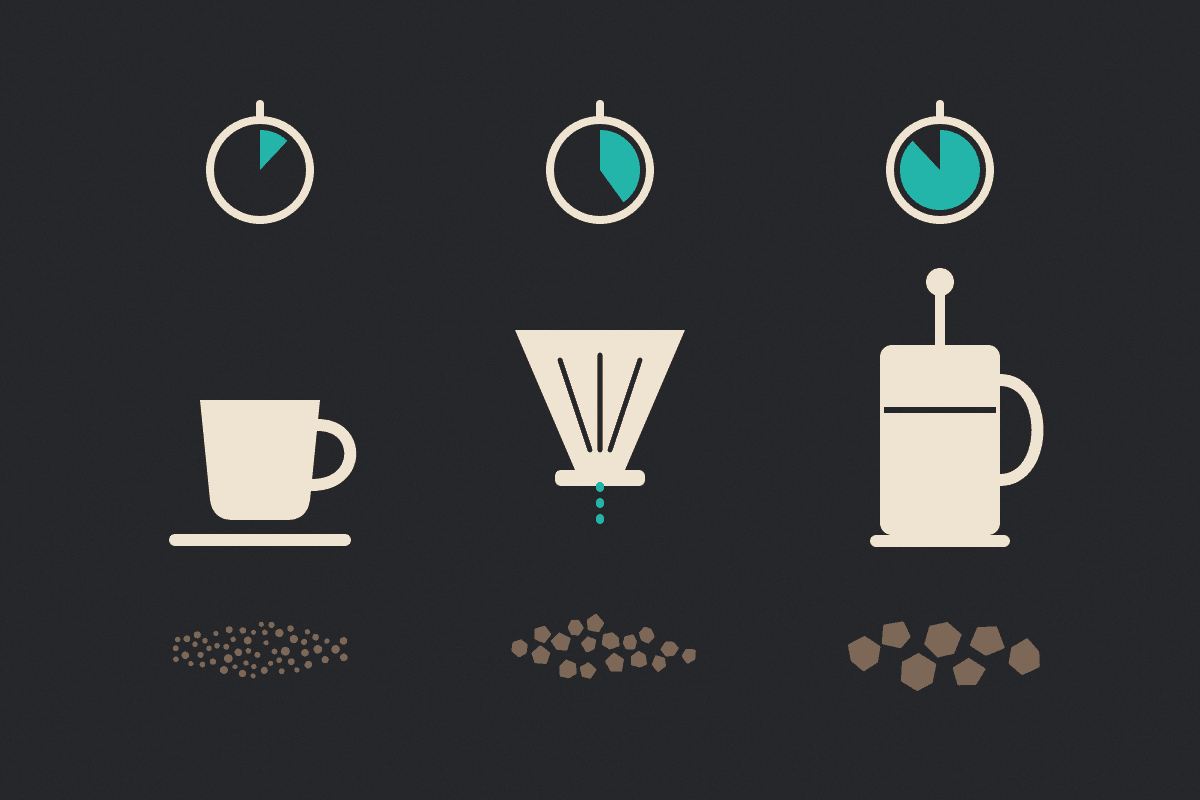
Short answer first. The less time the water spends with the coffee, the finer you grind. Espresso gets about half a minute, so it's ground fine. Cold brew gets most of a day, so it's ground coarse. Everything else lands in between.
TL;DR
- Match grind to contact time: short brews need fine grounds, long brews need coarse ones.
- Lab measurements put a typical espresso grind around 210 µm and a typical filter grind around 340 µm (median particle size) [1]. Past that, published numbers vary a lot, so trust your tongue over a chart.
- Sour or thin? Grind finer. Bitter or drying? Grind coarser. Change one step at a time.
The chart
Sizes are described the way a kitchen describes them, because every grinder numbers its dial differently. Microns are only listed where a measurement backs them up.
| Brewer | Grind | Roughly | Why |
|---|---|---|---|
| Espresso | Fine, like powdered sugar with a little grit | Median around 210 µm [1] | About 30 seconds under pressure. Fine grounds give the water enough surface to work fast, and they pack tight enough to hold back 9 bar. |
| Moka pot | Fine, a shade coarser than espresso | — | Short, hot and pushed by steam, but at far lower pressure. Espresso-fine can choke it. |
| AeroPress | Medium-fine, like table salt | — | A minute or two of steeping, then a press. Short contact time, so it wants a fairly fine grind. |
| Pour-over (V60) | Medium-fine to medium, like table salt to fine sand | Filter grinds median around 340 µm [1] | Three minutes or so of water running through the bed. The grind also sets how fast it drains. |
| Drip machine | Medium, like sand | Around 340 µm, as for filter [1] | Similar contact time to pour-over, but the machine sets the flow. Grind is the main lever you still have. |
| French press | Coarse, like coarse sea salt | — | Four minutes or more fully submerged. A coarse grind slows extraction down and keeps silt out of the cup. |
| Cold brew | Extra coarse, like cracked pepper | — | 12 to 24 hours in cold water. Coarse grounds keep a long steep from turning harsh, and they're easier to filter [3]. |
A note on those dashes: grind charts online disagree with each other by hundreds of microns for the same brewer, and most aren't measurements at all. We'd rather leave a cell empty than print a made-up number.
Why grind size matters: surface area
Coffee dissolves from the outside in. Water reaches the outside of each particle first, then has to work its way to the middle. Grind finer and two things happen at once: there's more outside for the water to touch, and less distance to the middle.
The geometry is simple. Cut a particle's diameter in half and the same dose of coffee has twice the surface area. So a fine grind extracts fast and a coarse grind extracts slowly. Choosing a grind size is really choosing a speed, then matching it to how long your brewer leaves the water in contact with the coffee.
Get the match wrong in one direction and the water leaves before it's done. The cup is under-extracted: sour, thin, a bit hollow. Get it wrong the other way and the water keeps going after the good stuff is gone, into the bitter, drying compounds that come out last. UC Davis researchers found that strength and extraction, not brew temperature, decided how drip coffee tasted. Grind size was one of the dials they turned to hit their targets [4].
Flow: the part a chart can't show
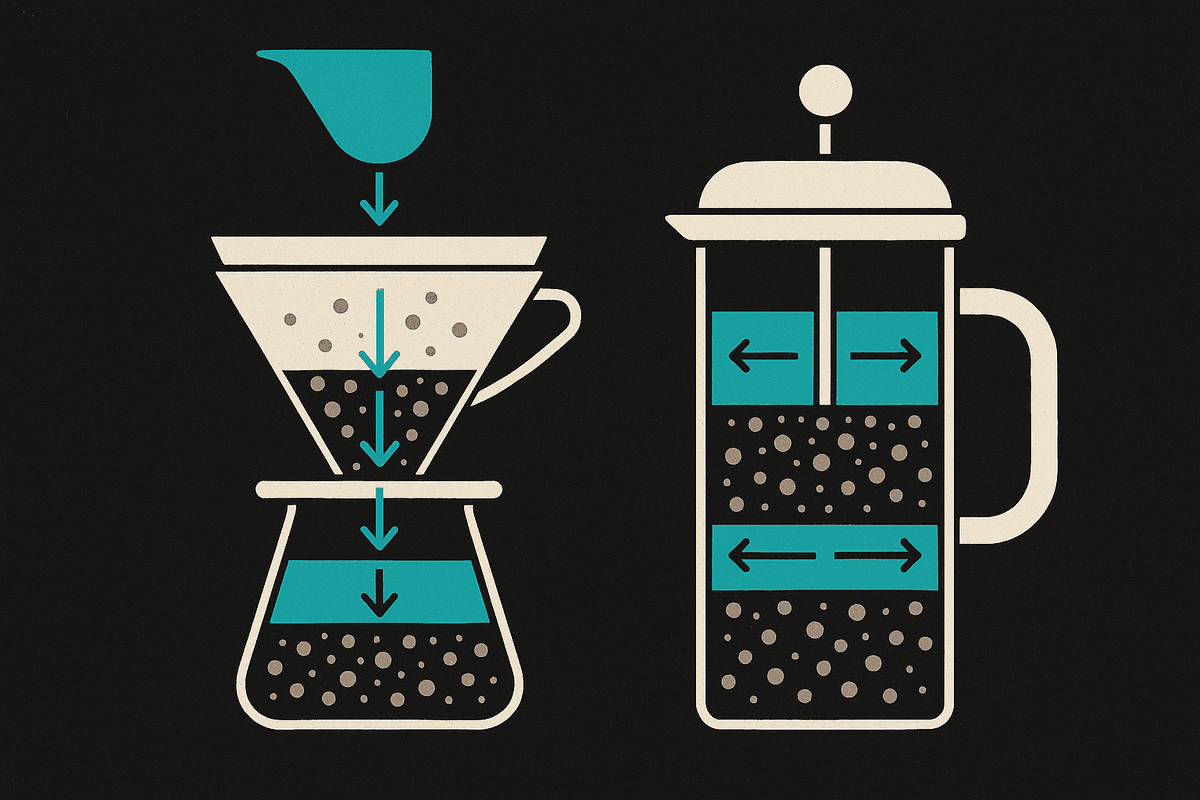
In brewers where water runs through the coffee (espresso, pour-over, drip), grind size also sets the flow. Finer grounds pack tighter, so water moves more slowly and spends longer in contact. Grind finer and you get faster extraction and a longer brew at the same time, which is why a small change can feel so big. We cover the two brewing styles in Percolation vs Immersion.
The smallest particles do much of this. Researchers in Switzerland added extra fines (particles under 100 µm) to espresso grinds and found the bed let less water through, flowed more slowly and took longer, while the fines barely changed how extraction itself worked [2]. That dust from your grinder is mostly a traffic problem. More in The Fines Problem.
Finer also isn't always better. A modeling and experimental study of espresso found that very fine grinds made water channel unevenly through the puck, so the shots extracted less, not more, and varied from shot to shot. Grinding coarser with a smaller dose gave more repeatable shots [5].
~30 s
Espresso time that tasters preferred, at 19–20% extraction [2]
Immersion is more forgiving
French press and cold brew don't rely on flow. All the coffee sits in the same water, so grind size only sets the speed, and the brew slows down by itself as the water fills up with coffee. That's why a coarse grind works there, and why a slightly-off grind costs you less than it would in a pour-over. Cold brew researchers found the best-scoring brews used a coarse grind and the shortest steep they tested, 14 hours [3].
How to dial in
Treat a chart as a starting point. Beans differ in roast and density, grinders differ in the particles they make, and you differ in what you like. Your tongue gets the final say.
Try this
- Start where the chart says. Brew your usual recipe at the suggested grind and keep the dose, water and ratio fixed.
- Taste for one thing. Sour, sharp or thin means under-extracted: go one step finer. Bitter, harsh or drying means over-extracted: go one step coarser.
- Watch the clock too. In a pour-over or espresso, a brew that runs much faster than the recipe usually tastes sour, and one that runs much slower usually tastes bitter. The time tells you which way to go before you taste.
- Change only the grind. Change grind and ratio together and you won't know which one fixed the cup.
- Stop when it tastes good. Sweet, balanced and clean is the goal, not a number on the dial.
Choosing a grind size is choosing a speed. Your brewer decides how long the water stays.
Pick your brewer above, open its guide, and start there. Follow the curve.