
Percolation vs Immersion: Why the Same Coffee Tastes Different
Take the same coffee, same dose, same water, same ratio, same temperature — put half in a pour-over, half in a French press. They won't taste the same. Not because one brewer is more skilled, or because a paper filter changes things chemically. The physics of how each method extracts compounds from the grounds is structurally different. The cup doesn't just pick up the flavors the coffee contains; it picks up the flavors the method allows.
TL;DR
- Percolation brewing (pour-over, drip) pushes fresh water through grounds continuously, keeping the concentration gradient steep from the first drop to the last — which sustains the driving force for extraction throughout [1].
- Immersion brewing (French press, cold brew) reaches a self-limiting equilibrium: as dissolved compounds build up in the liquid, the gradient narrows and extraction slows until it nearly stops on its own [1].
- The two methods don't just extract different amounts — they extract different compound profiles, which is why the same coffee genuinely tastes different depending on which regime you use [2].
How Percolation Works
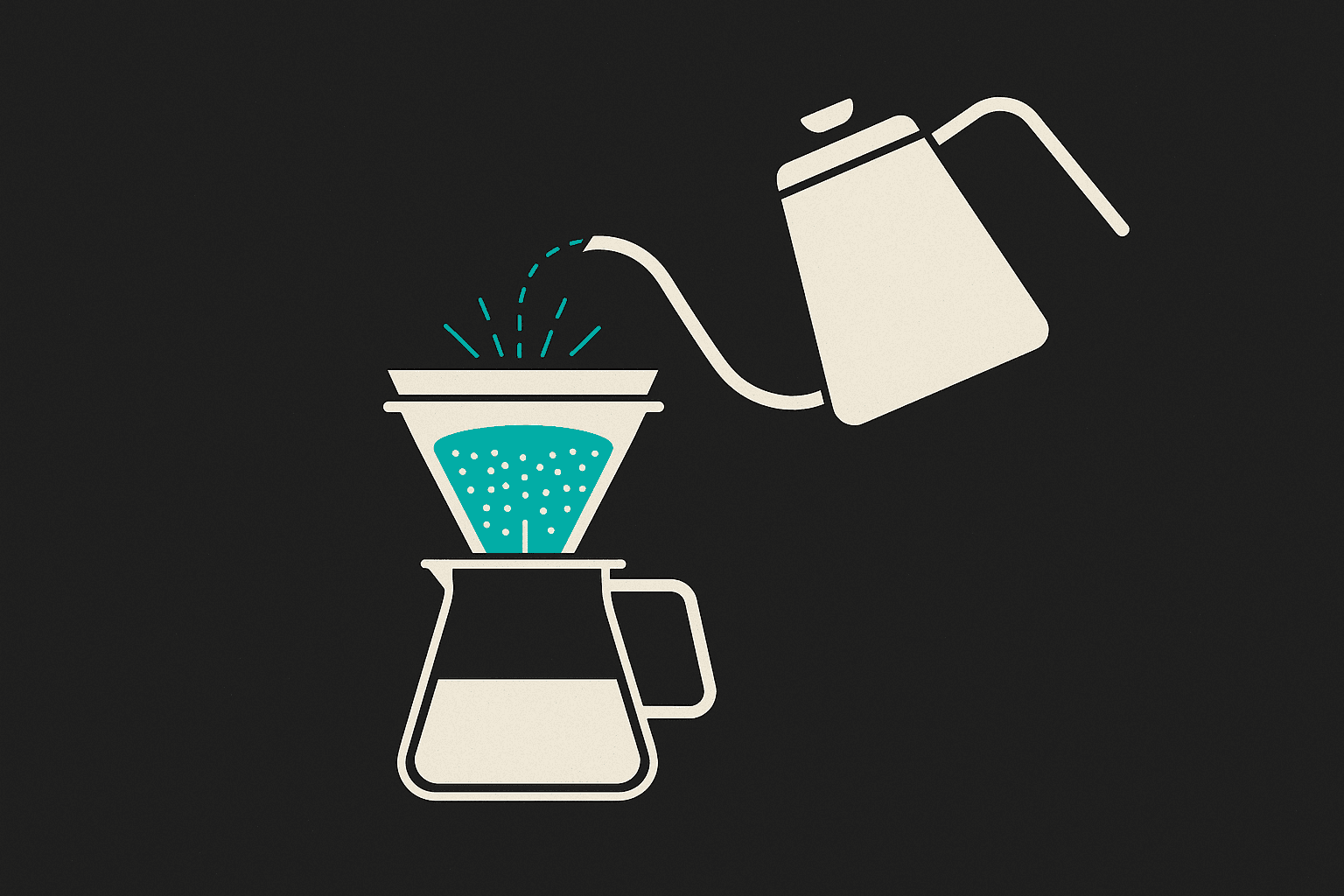
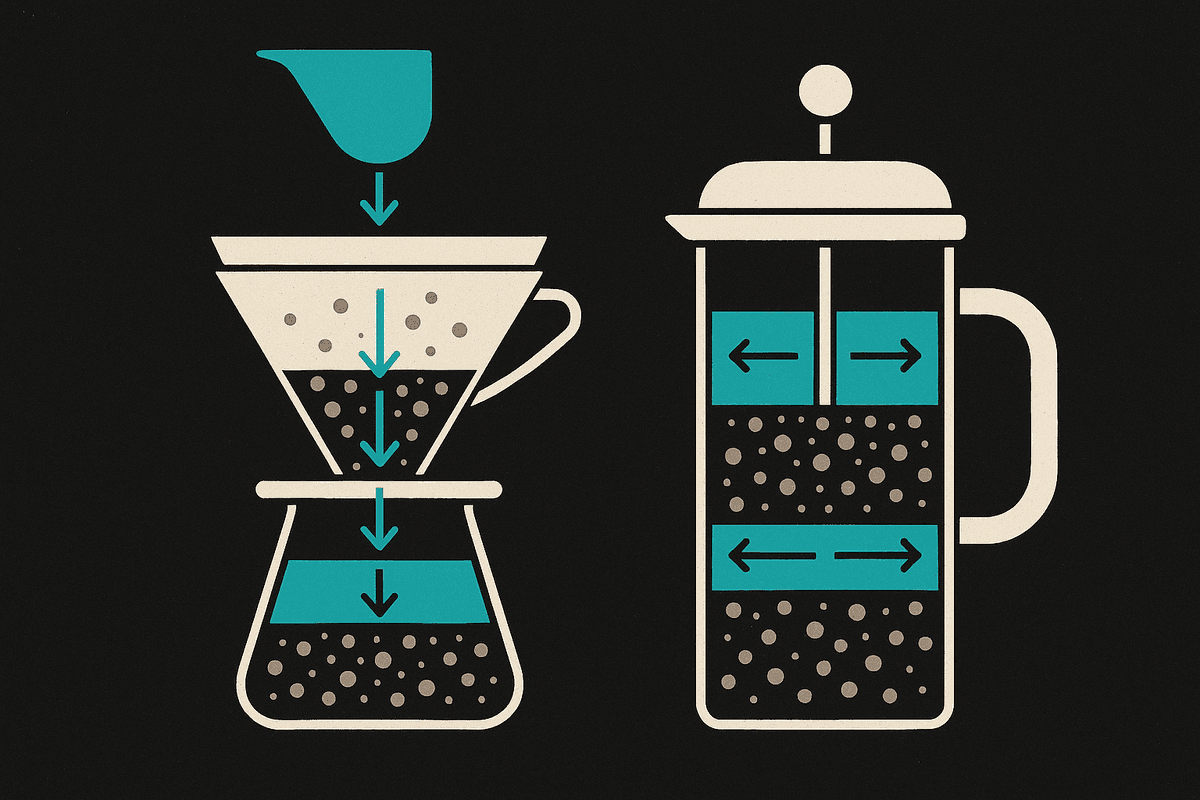
In percolation brewing, water flows through a bed of coffee grounds. The key word is through. Fresh water enters from above; brewed liquid exits from below. At any moment, the water arriving at a given layer of grounds is nearly clean — low concentration, high driving force.
That persistent gradient is what makes percolation so effective at chasing extraction. The difference in concentration between the fresh water and the still-loaded grounds stays steep. Each drop that exits is immediately replaced by one that hasn't extracted anything yet. The grounds never get a rest.
[!DATA value="High throughout" label="Concentration gradient in percolation — fresh water arrives continuously"]
This efficiency comes with a condition: the water has to move evenly. Channeling — water finding a preferential path through the bed — creates over-extracted channels and under-extracted dead zones. It's why grind distribution and pour technique matter so much in pour-over. You're managing a hydraulic process, not just wetting grounds. Small clumps, uneven distribution, or a lopsided pour creates a bed that extracts as several different beds at once [1].
How Immersion Works
In immersion brewing, grounds and water share a closed pool. Extraction starts immediately — the gradient is steep when everything is fresh — but the dynamics shift as compounds accumulate in the liquid.
Think of it as a narrowing gap. At the start, the water has nothing and the grounds have everything; extraction is fast. As compounds dissolve, the liquid concentration rises. The gap between what's in the liquid and what the grounds can still release narrows. Eventually, the two sides approach equilibrium: the liquid's concentration is close enough to the grounds' remaining extractable load that extraction effectively stops. The cup is done whether you press it or not [1].
Note
This self-limiting property is why cupping — the SCA's standard protocol for evaluating coffee — uses immersion at a fixed ratio and steep time [3]. Immersion is more reproducible across different grind sizes and operator technique than percolation, whose flow dynamics vary with how the bed is packed and poured. When you want to evaluate the coffee rather than the method, you use immersion.
This self-regulation makes immersion forgiving. A coarser grind doesn't mean under-extraction the way it might in pour-over — the grounds just need more time to approach equilibrium, not a faster flow rate. But it also means immersion can't push past its equilibrium ceiling without changing the recipe.
Here's what that ceiling means in practice: UC Davis researchers modeling full immersion brewing found that extraction yield converges to roughly the same value across a wide range of brew ratios — around 21% in hot immersion regardless of how much water you use [1]. Brew ratio changes cup strength (TDS), not extraction depth. If you want to extract more from the grounds, more time past equilibrium won't help. A finer grind, a higher temperature, or switching to percolation: those move the ceiling. Steeping longer past the equilibrium point: almost nothing changes.
The Flavor Consequence
These physics produce genuinely different cups from the same grounds.
Percolation's fresh-water advantage pulls hard on early-extracting compounds — the organic acids, simple sugars, and top-note aromatics that leave the grounds quickly [2]. The continuous flow means those first extractions are diluted as the brew progresses; they don't dominate the cup, they blend with what comes later. The result is clarity and brightness: flavors with distinct phases, high-note lift, clean finish.
Immersion's equilibrium approach extracts more uniformly across compound classes. As the gradient narrows, everything still in the grounds releases at roughly the same diminishing rate relative to what's left. Nothing gets pulled ahead of anything else. The cup tends to read rounder, more integrated, less bright — not lower quality, just built from a different distribution of what the grounds contain.
Percolation follows the gradient. Immersion finds the limit.
When the Two Meet
AeroPress in immersion mode, then pressed: it starts as immersion (compounds accumulating in the water), then becomes percolation as pressure pushes liquid through the puck. The press doesn't just speed up the pour — it shifts the extraction regime mid-brew [4]. This is partly why AeroPress produces such variable results with small recipe changes, and why the same recipe adjusted from a 1-minute steep to a 3-minute steep changes the cup more than the same adjustment in a pour-over would.
Bypass brewing — pulling a concentrated percolation then diluting with fresh water — uses the percolation gradient to pull a strong extract, then opens it with water that carries none of the equilibrium limit. The extraction physics were percolation; the final ratio looks like a longer immersion. The cup tastes like neither.
Try this
- Brew the same coffee in a pour-over and a French press back-to-back. Match dose, ratio, water temperature, and total time as closely as you can. Taste for brightness versus roundness — you're isolating the concentration gradient against the equilibrium limit.
- Try two AeroPress recipes. First: steep 2 minutes, stir, press quickly (immersion-dominant). Second: steep 20 seconds, invert, add water in a slow continuous pour through the grounds (percolation-dominant). The physics shift mid-recipe in both — the flavor shifts with them.
- Mid-steep dilution in French press. After 2 minutes, add 20g of fresh hot water. You've briefly reset the equilibrium, lowered the concentration gradient, and triggered a second extraction wave. The effect is subtle but real, and it only works in immersion.