

What Gives Coffee Its Body
Most coffee drinkers can feel the difference between an espresso and a filter brew — one coats the mouth, the other rinses through. That difference isn't strength. It isn't TDS. It's body: the tactile weight and viscosity you feel pressing against your tongue and palate. Three things build it. Each one can be isolated, exaggerated, or stripped entirely depending on how you roast and brew.
TL;DR
- Coffee body is built by three contributors: dissolved polysaccharides (viscosity), melanoidins (roast-derived weight), and oils (coating mouthfeel) [1].
- Galactomannans, the dominant polysaccharide in roasted coffee, dissolve into the brew and directly increase its viscosity [2].
- Paper filters trap 90–95% of coffee oils, stripping the heaviest mouthfeel contributor and lightening body dramatically [4].
The Carbohydrate Layer
Green coffee beans are roughly 50% polysaccharides by dry weight. The two that matter for your cup are galactomannans and arabinogalactans [1].
In green coffee, arabinogalactans are the majority — about 62% of the polysaccharide fraction. Roasting flips this. Heat degrades the more fragile arabinogalactans while preserving galactomannans, which become the dominant surviving polysaccharide. By the time ground coffee hits water, galactomannans account for roughly 69% of the polysaccharides that make it into the cup [2].
Galactomannans are long-chain sugars. They dissolve readily in hot water and raise viscosity — physically thickening the liquid. Not enough to coat a spoon, but enough to register as weight on the palate. This is the structural scaffolding of coffee body, present in every brew method from Aeropress to cold brew regardless of filter type.
[!DATA value="~50%" label="Polysaccharides as a share of green coffee bean dry weight"]
Melanoidins: The Roast Contribution
Melanoidins are the brown, high-molecular-weight polymers produced by the Maillard reaction. As roasting progresses, galactomannans get incorporated into melanoidin structures — becoming heavier, more complex, and more viscous in the cup [3].
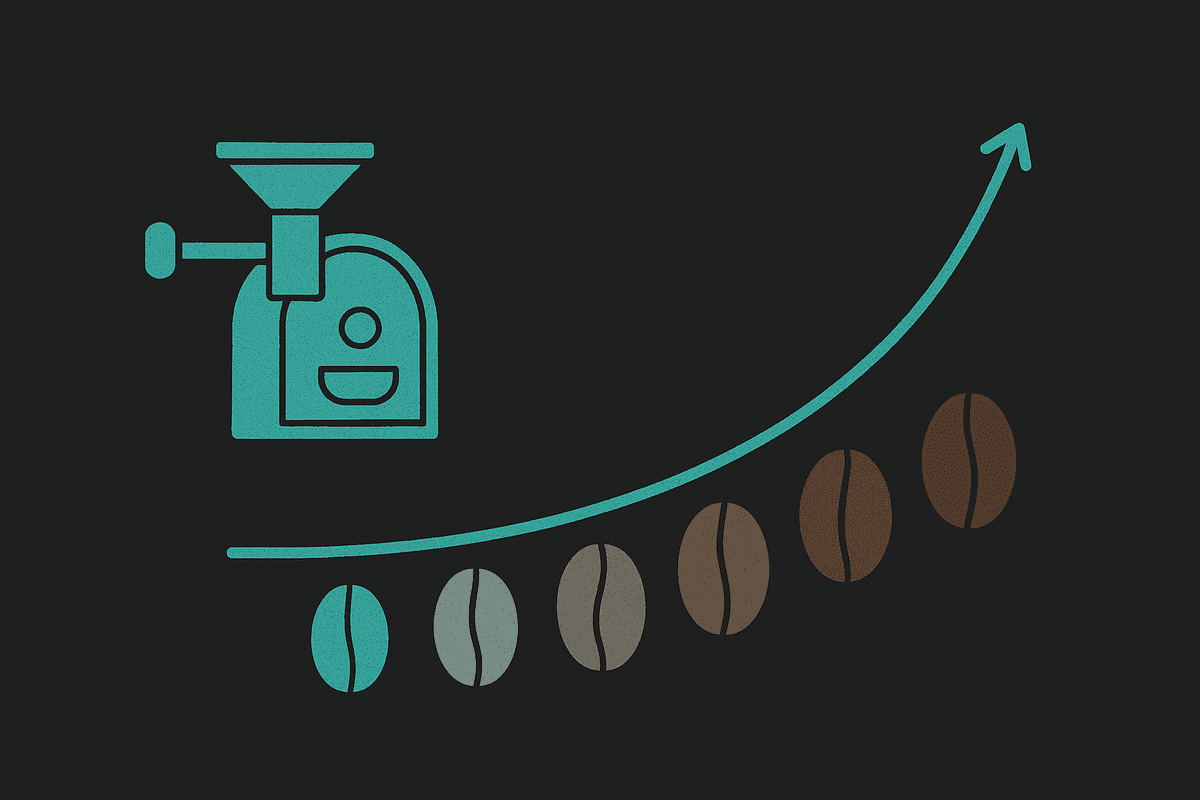
This is why dark-roast coffee typically feels heavier than a light roast from the same origin. More development time means more galactomannan-melanoidin fusion, meaning more high-molecular-weight material dissolving during extraction. The effect has a ceiling: viscosity peaks around medium roast (roughly Agtron 75) and begins declining in ultra-dark roasts as the polymer structures start to degrade [3].
The Maillard reaction's contribution to body is one reason "full body" and "bold flavor" tend to appear together on dark-roast labels. They're not the same thing, but they share a cause.
A longer Maillard phase stretches the roast's body ceiling. It also sets the flavor ceiling — and the two move together.
Oils: The Biggest Variable
Coffee beans are 10–15% lipid by dry weight. Most of that stays in the grounds. What makes it into the cup depends almost entirely on the filter.
Paper filters trap 90–95% of coffee oils [4]. Metal mesh — French press, Moka pot, most reusable filters — lets most of them through. Espresso under pressure doesn't just let oils through; it emulsifies them into the liquid, creating the coating, rounded texture that defines espresso mouthfeel. Those emulsified oil droplets physically cling to the palate in a way that dissolved sugars and polymers can't.
This is why French press and espresso feel categorically different from paper-filtered pour-over, even when TDS is similar. It isn't extraction strength — it's the presence or absence of oil droplets in suspension.
Try this
- Brew the same coffee two ways: once through a paper filter, once in a French press. Same dose, same water temperature, same ratio. Compare body. Flavor will track closely; the mouthfeel difference comes down almost entirely to filtration.
- Try a medium and dark roast of the same variety in a French press. Pull them at the same brew ratio so you're not just comparing concentration. The dark roast should read heavier — that's the melanoidin contribution adding molecular weight.
Why Body Is Not Strength
High TDS doesn't guarantee heavy body. A well-extracted light roast through paper can hit 1.5% TDS with a remarkably thin mouthfeel — because the dissolved solids are mostly acids, small sugars, and aromatic molecules, not the high-molecular-weight polymers that create viscosity.
Body tracks polysaccharides, melanoidins, and oils. Strength tracks dissolved solids overall. They correlate loosely, but you can build one without the other. A ristretto has both. A long cold brew filtered through paper can carry surprisingly high TDS alongside a clean, almost watery texture.
The cup is doing three things at once when you perceive it as "full" or "thin." Now you know which lever each one pulls.
Note
Arabinogalactans also act as prebiotic dietary fiber — the same molecule that thins out under roasting is what makes coffee a minor dietary fiber source. Body and fiber from the same polysaccharide class.