
TL;DR
- Every grinder spits out two populations of particles: chunks near your target size and a cloud of "fines" under ~100 microns.
- A 2024 paper in Scientific Reports showed the share of fines predicts espresso flow rate and extraction time better than median grind size does.
- Fines aren't evil. Too few = thin, watery cups. Too many = clogged bed, sour-bitter mess. The sweet spot is grinder-dependent.
What is a "fine," exactly?
When you grind coffee, you don't get a single particle size — you get a distribution. Plot it on a log scale and you'll almost always see two humps: a tall one around your target size (say, 300–800 microns for filter) and a smaller one way down at 20–50 microns. That second hump is the fines. Coffee scientists define them as particles under 100 microns, roughly the width of a human hair.
Fines aren't a grinder defect. They're inherent to how dry, roasted coffee fractures. When a burr splits a bean, the cell walls shatter into both big chunks and a shower of dust. No grinder on earth avoids this — not your Niche, not an EK43, not a $6,000 Mythos. The question is how much dust each machine makes, and where that dust sits in the distribution.
The "share of fines" — the volume percentage of particles under 100 microns — was a stronger predictor of flow rate and extraction time than the median particle size.
Why fines run the show
[!DATA value="<100 µm" label="Definition of coffee fines (particle diameter)"]
Here's the wild part: when researchers at illycaffè and the University of Trieste ran 180+ espresso shots across different grind settings, they found the "share of fines" — the volume percentage of particles under 100 microns — was a stronger predictor of flow rate and extraction time than the median particle size [1]. The dial on your grinder tells you about the big peak. The fines are the hidden variable.
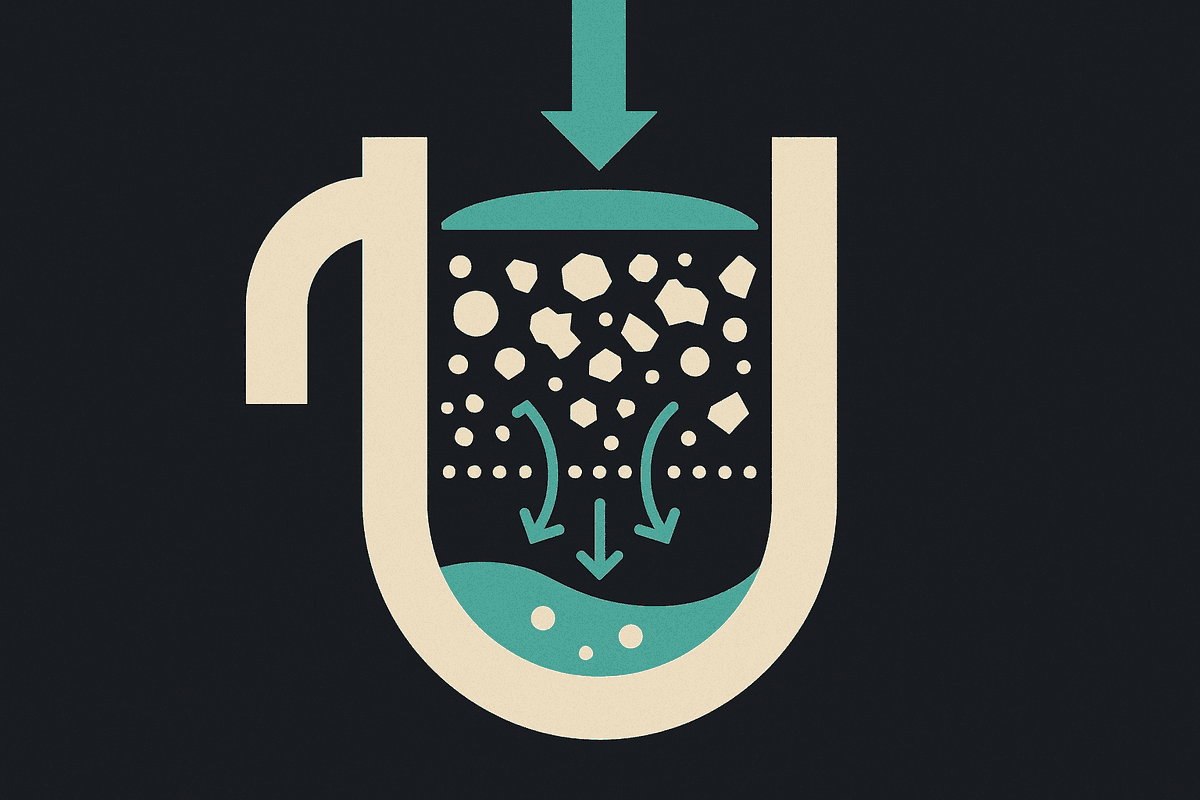
Why? Two reasons. First, fines pack into the gaps between bigger particles and wreck permeability — water can't flow through a clogged puck as easily, so extraction drags. Second, fines have an enormous surface-area-to-volume ratio. They give up their solubles almost instantly, which is great for strength but can tip fast into bitter and astringent if the contact time is too long.
Jonathan Gagné (the astrophysicist turned coffee-data nerd behind Coffee ad Astra) ran 300 particle-size distributions across 24 espresso grinders and found that burr alignment, geometry, and speed all move the fines needle independently of the average grind size [2]. Translation: two grinders set to "espresso fine" can produce wildly different cups because one is dumping twice the dust.
The Goldilocks problem
Fines aren't the enemy. Scott Rao calls a moderate amount of fines "the happy medium" — they add body, crema, and that syrupy mouthfeel we associate with a proper espresso [3]. Strip them out entirely (say, by sifting) and espresso turns watery and hollow; pour-over loses texture.
Too many fines, though, and you get what we see in the field when a grinder is overdue for burr cleaning: channels form, water punches through the thinnest part of the puck, and you taste sour and bitter in the same sip. That's the classic over/under extraction paradox — fines are over-extracting while boulders are barely getting touched.
For pour-over, most roasters chase a more unimodal distribution (fewer fines relative to the main peak) for clarity. For espresso, a controlled bimodal distribution is actually desirable — the fines build resistance and body [4].
Try this
- The sift test. Grind 30g at your normal filter setting. Run it through a cheap 150-micron sieve (a tea strainer works in a pinch). Brew the "boulders" and the "fines" as two separate V60s at the same ratio. The fines batch will taste sharp, bitter, muddy. The boulders will taste weak, sour, thin. Your normal brew is the balance between these two extremes — that's what fines are doing.
- Clean your burrs. If you haven't pulled your burrs in 3+ months, stale oils and micro-coffee are glued into the geometry, which kicks up fine production. Brush or ultrasonic clean them, then brew the same recipe before and after. Most people find the cup opens up — that's fines dropping back into a healthier ratio.
Sources
- Cordoba et al., "The role of fines in espresso extraction dynamics," Scientific Reports (2024).
- Jonathan Gagné, "What I learned from analyzing 300 particle size distributions for 24 espresso grinders," Coffee ad Astra (2023).
- Scott Rao, "The happy medium amount of fines," scottrao.com.
- Papel Espresso, "Understanding the Difference Between Bimodal and Unimodal Grind Distributions."