
Before Any Heat Touches It
Pick up a handful of specialty green coffee from a high-altitude origin. It feels almost like gravel. Then pick up a lower-altitude lot and the same-size bean is noticeably lighter. Same species. Different physics.
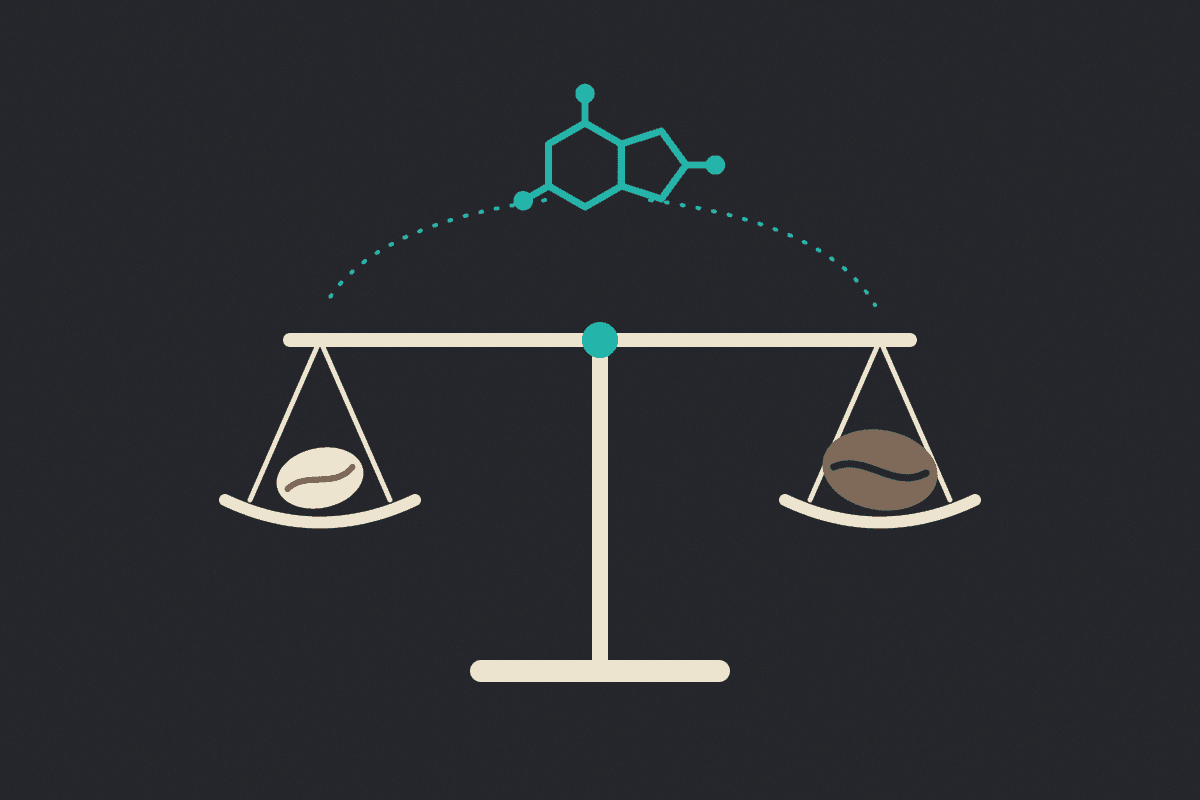
The difference is density: how much actual matter is packed into each bean. Bulk density — the simple measure where you fill a graduated cylinder, level it, and weigh it — typically runs from about 640 to 700 g/L for specialty Arabica [1]. Around 670 g/L is average; anything above roughly 690 g/L is dense, and 640 g/L is on the light end.
That number isn't just a grading footnote. It tells you something about how the bean grew — and how it will behave in the drum.
TL;DR
- Dense green beans, typically from high-altitude origins, have more compact cell structures and less pore space.
- That structure slows how heat moves from the surface to the bean's core during roasting, making the first phase longer and less forgiving.
- Roasters adjust early-phase heat for density; applying the same profile to beans of different densities can mean uneven development even when the color looks right.
Slow Growth, Tight Cells
Altitude is the main driver. A study in Nepal measured green beans from seven elevation bands between 800 and 1,500 meters: the highest band, 1,400–1,500 MASL, averaged about 688 kg/m³, while beans from 800–900 MASL came in around 620 [3]. A review of 73 studies on how growing conditions shape coffee quality found altitude was among the most consistent predictors of better cup scores [2].
The mechanism is temperature. Cooler highland nights slow the ripening of the cherry, which gives the seed more time to fill out before harvest [3]. The result is a more developed, more tightly packed seed: more matter in the same space.
~1,100 kg/m³
Approximate true density of green coffee before roasting
The Roaster's Geometry Problem
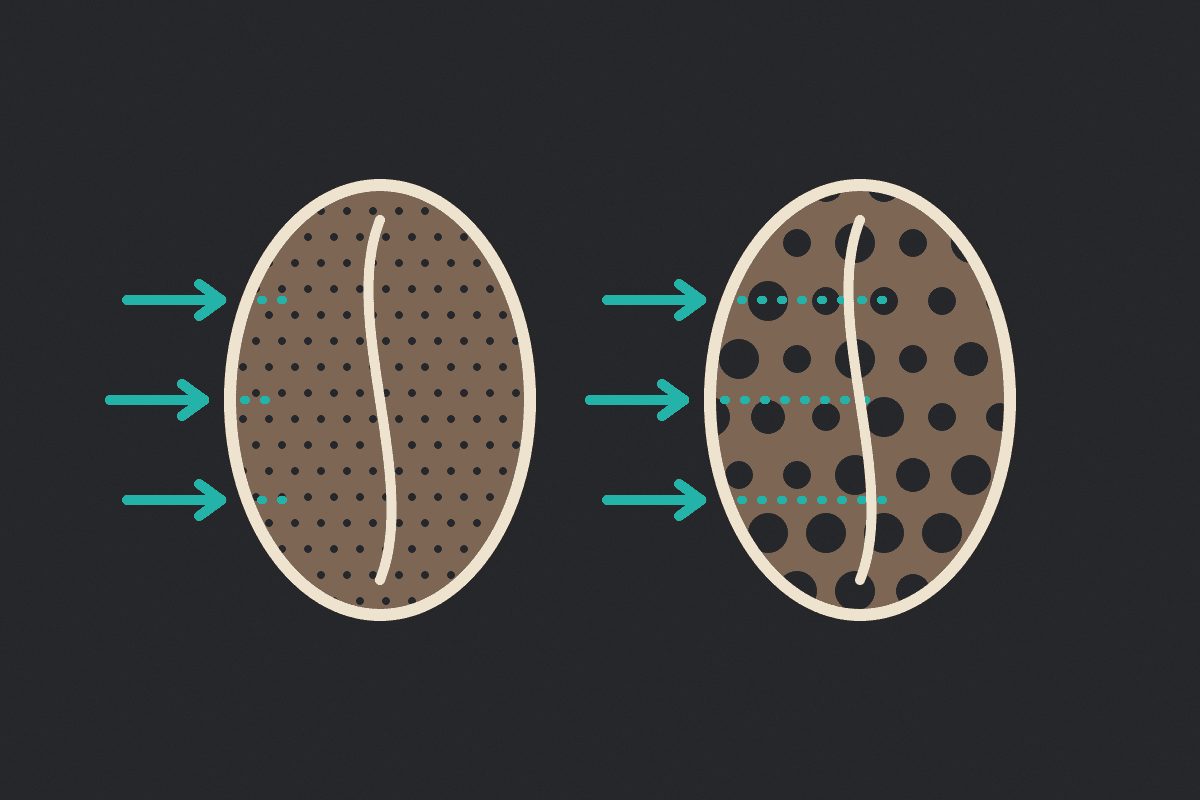
Coffee beans are porous bodies: a lattice of cellulose, arabinogalactans, and lignin, honeycombed with cells holding water, oils, and gases [4]. Heat has to travel through that structure to reach the core — and how porous the structure is determines how easily it can.
A denser bean has less air space and fewer open pathways. Roasters find it slower to take on heat early in the roast, when the surface is absorbing energy but the interior is still cold [3]. A less-dense bean, with more open structure, lets heat in more readily.
This asymmetry is what catches roasters off-guard. Apply the same profile to a dense highland lot and a lower-density lot from a warmer origin, and you'll get the same exterior color at the same time — but the interiors may be at very different temperatures. The denser bean's core is lagging.
Caution
Density alone can't predict a cupping score or certify that a bean is high-quality. Size, moisture content, and processing method all interact with how heat moves. Treat it as a starting point for your roast log, not a fixed rule.
What Roasting Does to Density
Density isn't static. As the roast progresses, it collapses.
True bean density falls from roughly 1,000–1,200 kg/m³ green to around 400–600 kg/m³ after roasting [5]. Two things drive that collapse: water turning to vapor and escaping, and CO₂ building pressure inside the cells until it ruptures the pore walls outward.
Research on hot-air roasting found that higher roasting temperatures produce greater bean volume, greater pore volume, and larger micropores in the cell walls [6] — the hotter the roast, the more structurally open the final bean. The tight structure you started with becomes a relatively open, fragile matrix by the time the beans reach the cooling tray.
How dense the green bean was before the drum shapes how that transformation plays out. Roasters generally find a denser bean takes heat more slowly at the start, then carries it through more efficiently once it gets going [3], so it often wants more energy early to reach first crack on schedule.
Try this
- Fill-and-weigh. No special equipment needed. Fill a 500 ml measuring cup with green beans, level the top, and weigh it. Divide grams by milliliters. Above 0.69 g/ml is dense; 0.64 or below is on the lighter end. Compare a couple of different lots in your pantry.
- Same color, different feel. If you roast at home, try the same total roast time on two lots at noticeably different densities and cup them. The denser bean may taste underdeveloped even when the color looks identical — its core lagged behind the surface.
A dense bean had more time to become itself. The roaster's job is to give it enough time in the drum to finish what the growing started.