

TL;DR
- A 2025 Physics of Fluids paper from UPenn used transparent silica-gel "stand-in" grounds to film the jet crashing into the bed and saw the water dig a crater that keeps avalanching — stirring the slurry from the inside.
- The taller the pour (up to the point the jet breaks into droplets), the bigger the avalanche and the stronger the cup at the same dose.
- Thicker, laminar streams from a gooseneck kettle preserve the avalanche; skinny, wobbly streams collapse into droplets, drag air into the bed, and kill the effect.
The experiment (with gel, not coffee)
Coffee's one of the worst things to film. It's opaque, messy, and the second water hits it you can't see anything. So Ernest Park, Margot Young, and Arnold Mathijssen at the University of Pennsylvania swapped the grounds for transparent silica-gel particles in a glass V60, shot a laser sheet through the side, and rolled a high-speed camera [1][2].
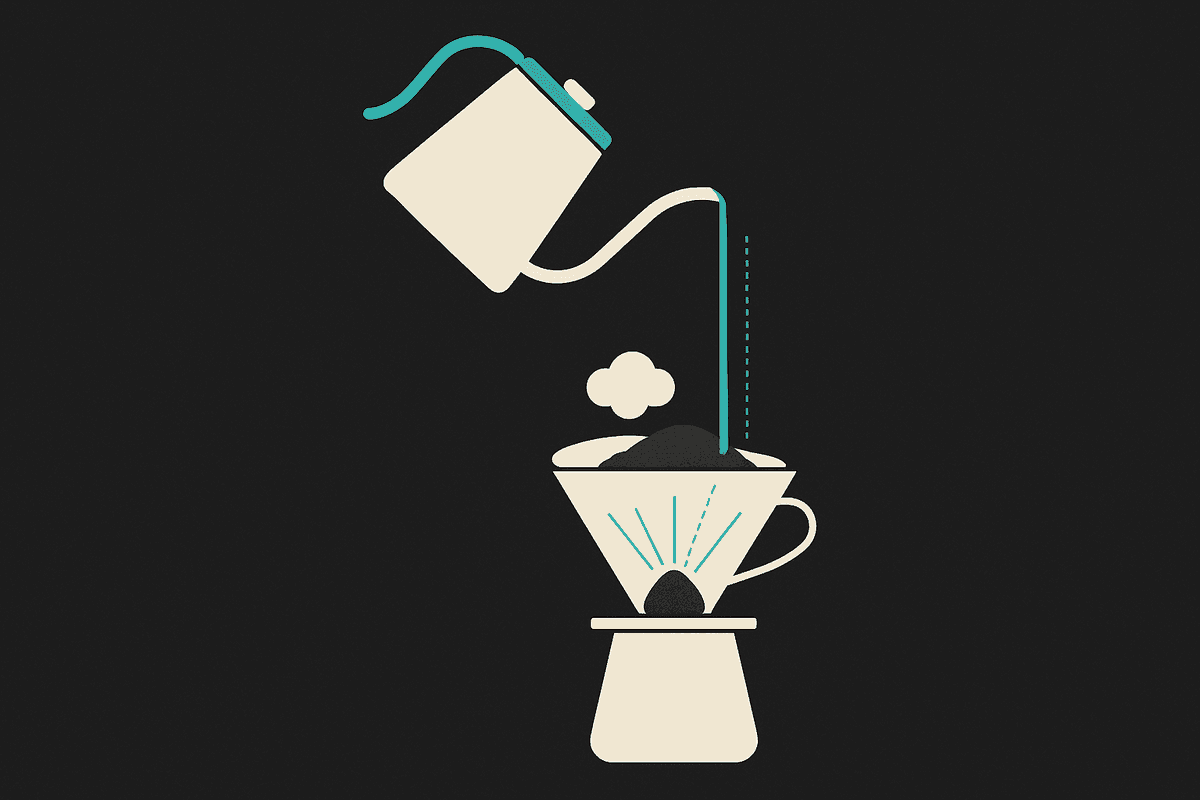
What they saw is wild. A steady water jet doesn't just sit on top of the bed and soak down — it punches a crater, and the edges of that crater keep caving in. Grains slide down the wall of the pit, tumble under the jet, get pushed back up the far side, and fall again. An actual avalanche loop inside your brewer, running the whole time you pour. That constant churn is what mixes water with grounds, and mixing is what extraction lives or dies on.
The crater keeps caving in — grains avalanche, tumble under the jet, rise again. It's a circulation loop inside your brewer, not just water soaking down.
Why pour height suddenly matters
[!DATA value="50 cm" label="Max practical pour height before jet breaks into droplets"]
Here's the part that rewrites a piece of common advice. The higher you pour, the more momentum the water has when it lands, and the bigger the avalanche it kicks up. The UPenn team found that with a standard-thickness jet (your normal gooseneck kettle), higher pours produced measurably stronger coffee at the same dose and same total water [1][3]. Penn Today summarized the takeaway as literally "stronger coffee with fewer beans" [2].
There's a ceiling, though. Push the kettle too high and the stream stops being a stream — it breaks into droplets. Droplets tumble through the air, drag oxygen bubbles into the slurry, land unevenly, and the avalanche collapses. The paper's rule of thumb: pour as high as you can while keeping the jet laminar, meaning smooth, continuous, and not splintered [1][4]. The breakdown point depends on your kettle and flow rate, but the common cutoff floating around the reporting is roughly 50 cm — beyond that almost every stream shatters [5].
Why your cheap kettle can't do this
The reason the specialty world made such a fuss about gooseneck kettles wasn't aesthetics. It's fluid dynamics. A long, narrow, curved spout stabilizes the jet — it comes out as a clean column instead of a chaotic dump. That's what makes laminar flow possible at useful heights. Jonathan Gagné's 2020 breakdown of kettle physics on Coffee ad Astra made the same point years before UPenn confirmed it with data: jet geometry changes the slurry behavior more than most people realize [6].
Thin jets, like the ones marketed for "gentle" pours, hit a different problem. The UPenn paper found that when the water jet gets too thin, pour height barely matters — the jet can't generate enough momentum to drive an avalanche at any reasonable height [1]. Thick but controlled is the sweet spot.
What this changes about your recipe
Most pour-over tutorials, including Hoffmann's V60 walkthrough, tell you to hover close and pour gently to avoid agitation. That's still good advice for protecting the filter walls and keeping fines from migrating. But the UPenn data says you've been leaving extraction on the table during the main pours — specifically in the middle of the cone, where a taller pour gets the whole bed moving.
The practical read: stop pouring from two centimeters above the grounds. Lift the kettle. Let the stream do some work.
Try this
- The height swap. Brew your normal V60 recipe twice — same grind, same dose, same water, same time. Brew A: pour with the spout basically touching the bloom and the pours. Brew B: on the main pours, lift the spout to roughly 15–20 cm above the bed, keeping a thick, unbroken stream from a gooseneck. Taste side by side. Brew B should come across stronger and more extracted. If it's muddy, your stream probably broke into droplets — bring the height down a few centimeters.
- The dose cut. Once you've nailed the taller pour, try dropping your dose by 1 gram at the same ratio and same pour height. The UPenn team's whole framing is "more flavor from fewer beans" — at PQN we find there's usually 5–10% of dose you can claw back once the avalanche is doing the mixing for you [2][3].
Sources [1] Park, Young, Mathijssen — "Pour-over coffee: Mixing by a water jet impinging on a granular bed with avalanche dynamics," Physics of Fluids (April 2025). [2] Penn Today — "For a better cup of coffee, look to physics" (April 2025). [3] ScienceDaily — "Stronger coffee with fewer coffee beans" (April 8, 2025). [4] Phys.org — "Unveiling the physics of pour-over brewing: Thick water jets enhance coffee strength" (April 2025). [5] Daily Coffee News — "Physicists Propose Coffee-Saving Hack to Pourover Brewing" (July 2025). [6] Jonathan Gagné — "The Physics of Kettle Streams," Coffee ad Astra (2020).