

The Bitterness Cascade
There's a compound in your green coffee that does more to shape bitterness than caffeine ever will — and most people who care deeply about coffee have never thought about it directly.
Chlorogenic acids (CGAs) are phenolic compounds that account for 3.5–7.5% of Arabica's dry weight in the green bean [1]. Robusta carries more: 7–14%. They're not the same family as the citric and malic acids that give coffee its bright, fruity acidity — those are the aliphatic carboxylic acids. CGAs are in a different class, and they do very different things when heat gets involved.
TL;DR
- Chlorogenic acids make up 3.5–7.5% of Arabica's dry weight in the green bean — and dark roasting converts roughly 85% of them into other compounds.
- Roasting drives a two-stage cascade: CGAs become lactones (the clean bitterness of medium roasts), then lactones become phenylindanes (the harsh, lingering bitterness of dark roasts).
- Caffeine accounts for only ~15% of coffee's perceived bitterness. The real drivers are CGA breakdown products created by the roast itself.
Stage One: Green Bean to Lactone
As bean temperatures climb through the roast, chlorogenic acids begin folding in on themselves. The quinic acid component of each CGA molecule loses a water molecule and forms an internal bond — a reaction called lactonization — creating chlorogenic acid lactones (CGLs) [2].
CGLs are bitter. Not in an unpleasant way at medium concentrations, but measurably — their bitterness thresholds range from about 10 to 180 μmol/L depending on structure, and human sensory panels consistently detect them at concentrations found in brewed coffee [3]. By the time a coffee reaches medium roast, most of the parent CGAs have converted into lactones. That conversion is a significant part of what you're tasting when you drink a well-developed medium: clean, structured bitterness with a relatively short finish.
Medium-roast bitterness is largely CGL bitterness.
Stage Two: Lactone to Phenylindane
Continue roasting into dark territory and the lactones themselves start to break down further. The quinic acid end splits off, and through a further cascade of oxidation and polymerization steps, you get phenylindanes — a family of polyhydroxylated compounds that taste harsh, metallic, and linger long after the sip [4].
This is Thomas Hofmann's research at TU Munich, published in 2007, and it reshuffled what the industry thought it understood about coffee bitterness. The central finding: caffeine accounts for only about 15% of coffee's perceived bitterness. CGLs and phenylindanes — both roasting byproducts of chlorogenic acids — do most of the work [4].
[!DATA value="~15%" label="Perceived coffee bitterness attributable to caffeine — roasting byproducts from CGAs drive the rest"]
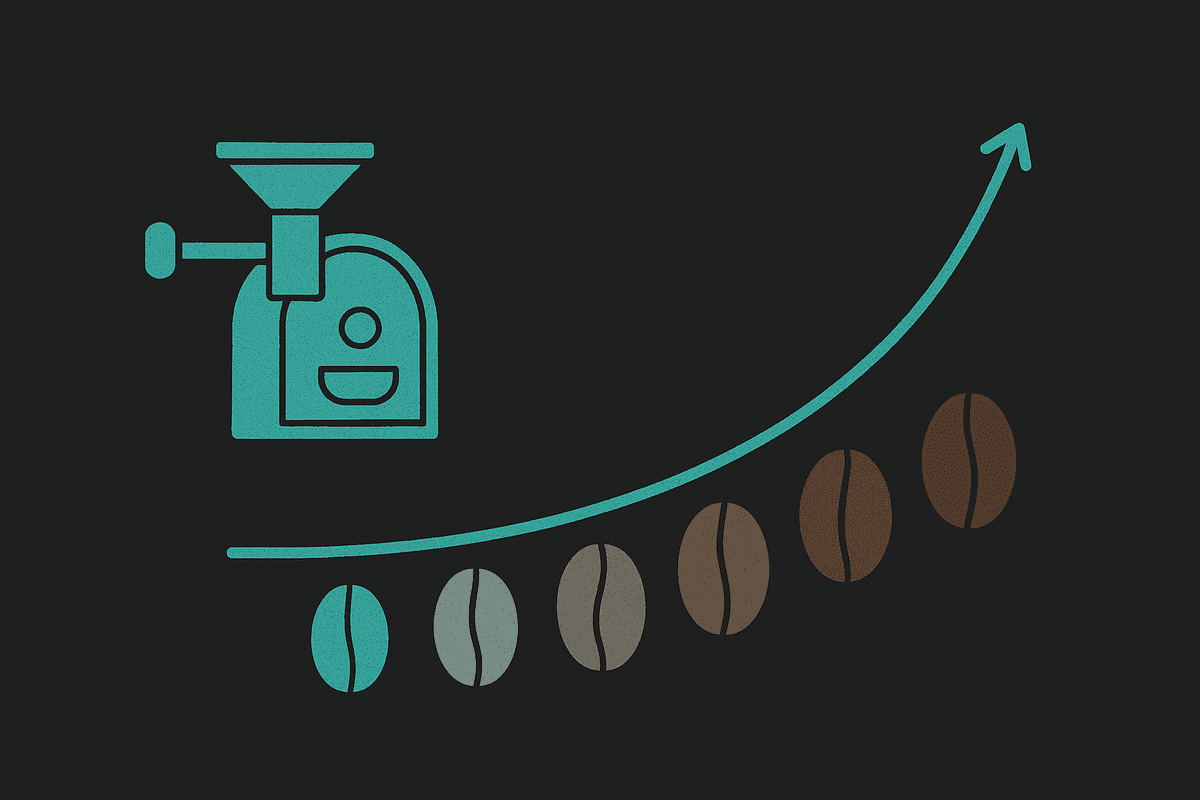
The progression is: CGA → CGA lactone → phenylindane. More roast time and temperature means you're further down the cascade, and the character of bitterness shifts from medium-roast clean to dark-roast coating and persistent.
The roasting process, not caffeine, is the dominant determinant of coffee's perceived bitterness.
What Happens to the Quinic Acid
The conversion of CGAs also releases quinic acid as a byproduct. Quinic acid builds up through roasting, and it continues to be released when brewed coffee sits on heat [5]. This is one reason coffee left on a burner tastes worse over time — quinic acid concentrations rise as residual CGAs degrade further in the liquid, pushing the cup from pleasantly bitter toward sharp and sour-bitter.
Caution
Brewed coffee continues to degrade on heat. Quinic acid concentrations rise within 20–30 minutes of brewing, sharpening the bitterness noticeably. Move leftovers into an insulated flask rather than keeping them warm on a plate.
Reading a Roast Level Through the Chemistry
By dark roast, roughly 85% of the original CGA content has been converted — into lactones, into phenylindanes, into quinic acid and caffeic acid fragments [1]. "Less acidic" is one way to describe a dark roast, but "structurally rearranged" is more accurate. The compounds are still there; they've just become something else.
Light roasts retain most of their CGAs. They can be mildly astringent because CGAs bind to salivary proteins and produce a drying mouthfeel [5] — the same mechanism that makes tea slightly puckering. The bitterness is subtle, sometimes barely present. What you're tasting is closer to the raw phenolic content of the bean itself.
Medium roasts have largely converted CGAs to lactones: structured, bounded bitterness that clears relatively quickly.
Dark roasts have pushed into phenylindanes: the bitterness that coats the mouth and persists well after swallowing.
Understanding this cascade doesn't tell you which roast to prefer. It tells you what you're actually tasting when you do.
Try this
- Same origin, two roasts. Brew a light and a dark roast of the same coffee side by side at the same dose and ratio. Focus on the character of the bitterness — brief and clean, or coating and lingering? That difference is the CGL-to-phenylindane shift showing up on your palate.
- Let it cool. Aromatic volatiles mask bitterness at high temperatures. As the cup cools, sweetness fades faster than the bitter compounds, and the cascade's products become more prominent. It's not over-extraction — it's chemistry that was always there, becoming harder to ignore.