

The Brightness Question
You've tasted it — that zip of citrus, that clean-edged lift that makes a light-roast coffee feel alive in the mouth. "Acidity" in coffee shorthand. Specialty culture celebrates it; people new to specialty often distrust it. And for a long time, the explanation stayed frustratingly vague: light roasts are bright because they're acidic, dark roasts aren't.
That answer isn't wrong. It's incomplete.
Brewed coffee contains more than 30 identified organic acids [1]. They don't all taste the same, they don't all survive the roaster equally, and the ones you'd expect to drive flavor aren't always the ones doing the work.
TL;DR
- Brewed coffee has 30+ organic acids, but most are present below their individual sensory detection thresholds.
- Acidity perception is emergent — a property of the whole mixture, not any single compound.
- Chlorogenic acid (the most abundant in the green bean) degrades during roasting into quinic acid: the source of dark roast's drying bitterness.
The Lineup
The major organic acids in arabica include citric, malic, lactic, acetic, quinic, phosphoric, and chlorogenic. They come from different places.
Citric and malic are native to the green bean — the same compounds you'd find in a lemon or an unripe apple. They survive light roasting better than most. Citric reads as clean, bright citrus. Malic is softer: green apple, stone fruit, a gentle roundness.
Lactic and acetic acids form primarily during processing, especially in fermented or naturally processed lots. Lactic adds a creamy, yogurt-like smoothness. Acetic at low levels adds complexity; at high levels it sharpens into vinegar — a fault marker when processing goes wrong.
[!DATA value="6–10%" label="Chlorogenic acid as share of dry weight in green arabica"]
Chlorogenic acid is the heavyweight. In a green arabica bean it makes up 6–10% of dry weight [2] — more than any other non-fiber compound. It's the primary reason coffee carries measurable antioxidant activity. And it's the reason dark roasts taste the way they do.
The Threshold Problem
Here's the counterintuitive part.
A 2023 study measured organic acid concentrations in brewed coffee, then tested how those acids perform against trained tasters [3]. The result: most individual acids — malic, acetic, lactic — are present in brewed coffee below their sensory detection thresholds. Citric was the only one consistently detectable at actual cup concentrations. When coffee experts were given coffee spiked with additional acids at realistic concentrations, they couldn't correctly identify which acid had been added.
Acidity in coffee isn't one compound at one threshold. It's dozens of acids adding up to something none of them could produce alone.
This doesn't make the acids irrelevant. It means acidity is emergent — a property of the whole mixture, not the loudest single component. The combination and ratio of acids matters more than any individual concentration. It's why coffees with similar pH readings can taste completely different.
What Roasting Does
Roasting rewrites the acid profile. Light roasts preserve more of the native citric and malic acids. Darker roasts degrade them while simultaneously generating more lactic, acetic, and glycolic acids [1].
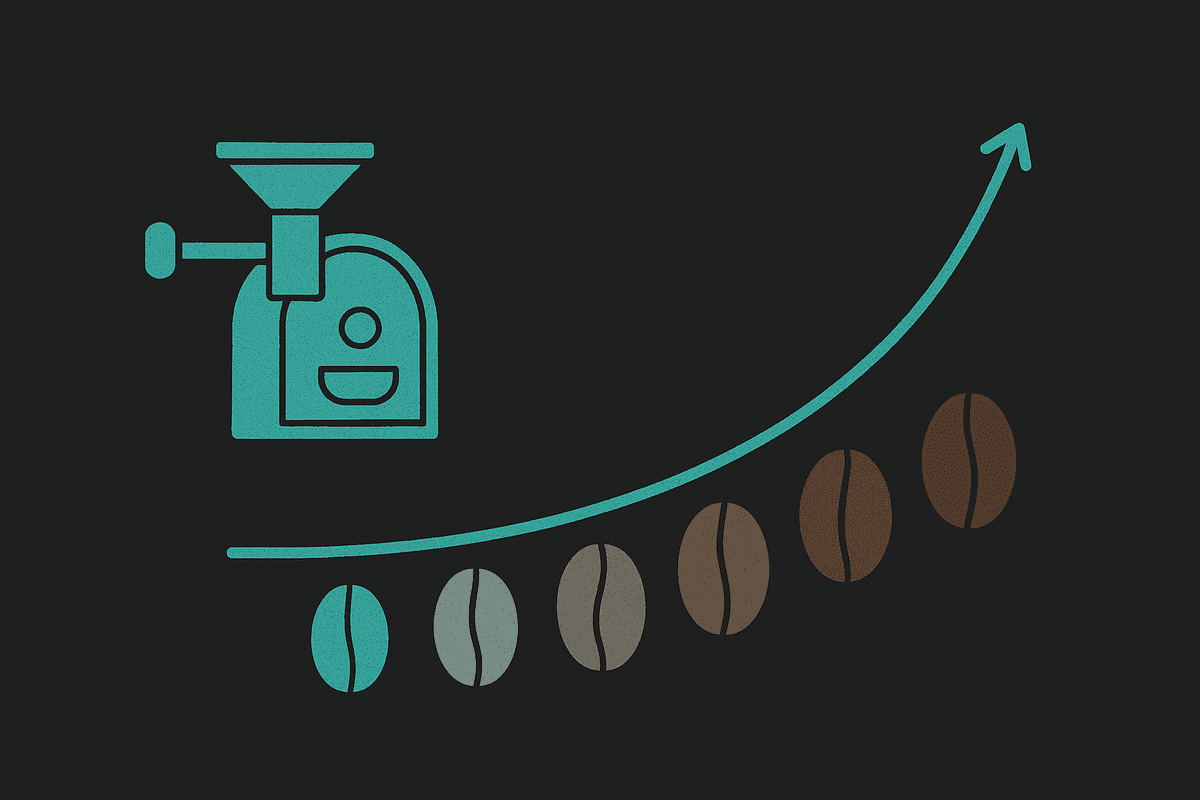
The most consequential transformation involves chlorogenic acid. Starting around 160°C it begins breaking down — losing roughly 50% by light roast and over 80% by dark roast temperatures [4]. The breakdown products: quinic acid and caffeic acid. Quinic acid is the compound responsible for the dry, drying, slightly astringent bitterness in dark cups. The brightness doesn't disappear — it converts. Chlorogenic acid's clean polyphenolic structure becomes quinic acid's harsh, lingering bite.
Note
Chlorogenic acid lactones — ring-closed forms that develop mid-roast — are even more bitter than the parent acid. Research identifies them, alongside phenylindans that form later, as among the most potent bitter compounds in roasted coffee [5].
Light roast brightness and dark roast bitterness share an ancestor. It's the same compound at different stages of thermal degradation.
What to Do With This
You can't dial individual acids up or down through brew parameters alone. But a few levers exist.
Processing shapes the starting point before the roaster touches it. Washed lots tend toward cleaner citric and malic brightness. Naturals and fermented lots introduce more lactic character — rounder, fruit-adjacent, or funky depending on where the fermentation landed. You're tasting microbiology as much as chemistry.
Roast level is the biggest variable. If you want structural brightness, you need coffee where chlorogenic acid hasn't fully converted. A light roast preserves the original acids; a dark roast trades them for something else entirely.
Brew temperature matters at the margin. Cooler water extracts acidic compounds more readily than bitter ones — hotter water pulls everything, including the quinic acids and bitter lactones from darker roasts.
Try this
- Process comparison. Find the same variety in washed and natural versions. Brew both at the same ratio and temperature. The washed cup will likely read cleaner and citrus-forward; the natural, rounder and more fruit-inflected. You're tasting the fermentation chemistry.
- Temperature and bitterness. Take a medium-dark roast and brew one batch at 93°C, another at 85°C. The cooler cup extracts acids more preferentially over bitter quinic compounds — it should read noticeably less harsh despite identical dose and grind.