
Sweet Without Sugar
You know the feeling: a sip of well-made light roast that lands unexpectedly sweet. Not sugary — sweet, in the clean, fruit-adjacent way a good peach is sweet. No milk, no sugar added.
It's not your imagination. But it's also not sugar.
TL;DR
- Green Arabica beans contain 6–9% sucrose by dry weight — roughly comparable to fresh strawberries. Almost all of it is gone by medium roast.
- Yet medium roast consistently scores highest for perceived sweetness in trained sensory panel tests. The sugar disappears; the sweetness doesn't.
- A caramel-scented compound called furaneol, formed directly from sucrose during roasting, is the primary reason. It enhances sweetness perception through your retronasal olfactory system — not your tongue.
Where the Sugar Starts
Green Arabica is surprisingly sweet, on paper. Sucrose makes up roughly 6–9% of dry bean weight [1] — more than you'd find in a typical apple, slightly more than a fresh strawberry. It's one reason Arabica tastes cleaner than Robusta, which carries roughly half as much.
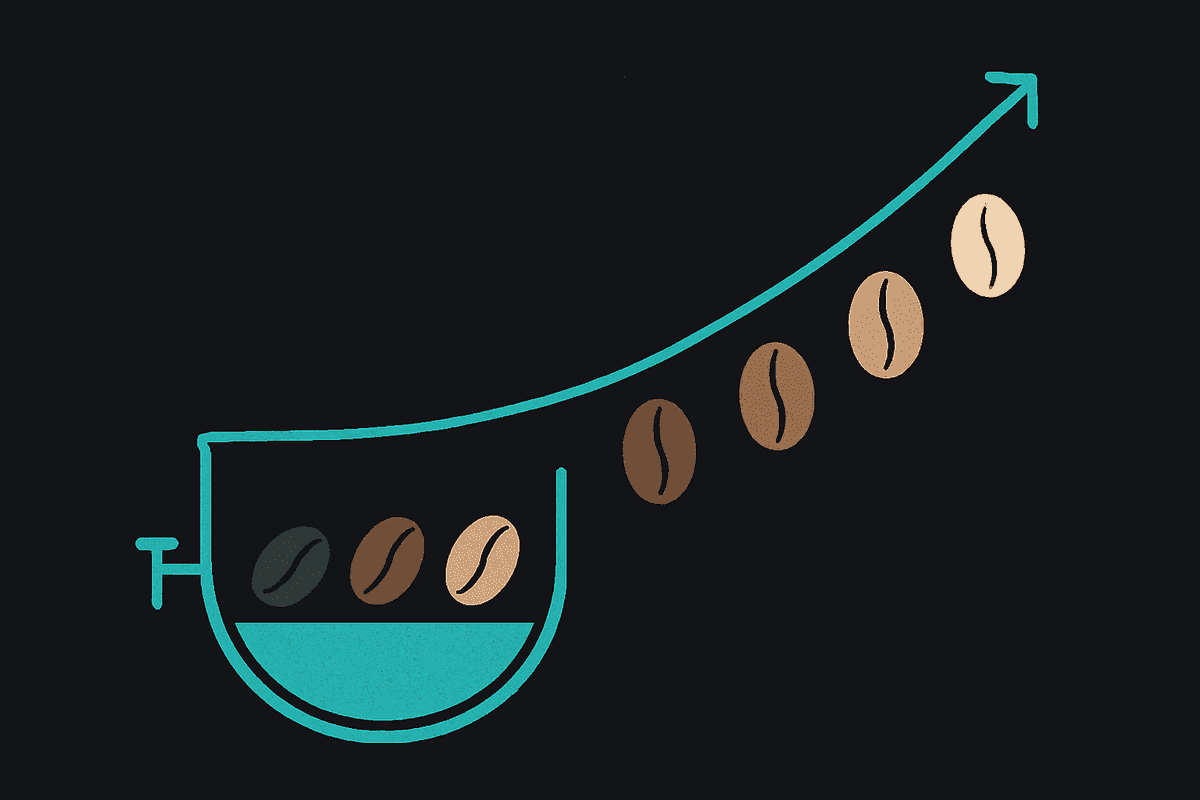
None of it survives to your cup. By light roast, perhaps 3% of the original sucrose remains; by medium roast, effectively none [2]. What your cup contains is everything sucrose turned into during its 200°C journey through the drum.
[!DATA value="6–9%" label="Sucrose as share of dry weight in green Arabica beans — essentially all of it consumed by roasting"]
The Compound That Does the Work
During roasting, sucrose degrades along several pathways simultaneously: caramelization products, Maillard reaction intermediates, CO₂, water. One of those pathways generates furaneol — formally 4-hydroxy-2,5-dimethyl-3(2H)-furanone — a volatile compound with a sharp caramel and pineapple character [3].
Furaneol is one of the character compounds in strawberries, pineapple, and caramel candy. Its formation in coffee has been traced directly to sucrose as a precursor, and its output shifts with roast degree: light roasts produce less, medium roasts peak, dark roasts generate more but bury it under harsher pyrazines and phenylindanes [3].
Furaneol doesn't taste sweet — your tongue's sucrose receptors don't respond to it. But your nose picks it up as caramel, and what the nose detects retronasally gets integrated by your brain as part of the flavor, including sweetness. This is the crossmodal mechanism: volatile aroma compounds don't just smell sweet, they make things taste sweeter [4].
Why Smell Changes What Your Tongue Reports
The retronasal route runs from the back of your throat up into the nasal cavity as you exhale and swallow. Aroma reaching your olfactory epithelium this way is processed alongside what your tongue is detecting — the brain integrates them as a single sensory signal, not two separate streams.
Research on aroma-taste interaction has shown that even subthreshold odor stimulation — below what you'd consciously detect as a smell — can measurably enhance perceived sweetness [4]. The brain fills in. A caramel aroma alongside moderate organic acids reads as a sweeter cup, not because the sweetness intensity is higher in the liquid, but because the combined signal is louder.
Note
This is why nose-pinched coffee tastes flat and slightly harsh. You're not just losing aroma — you're losing a significant portion of what your brain was reading as sweetness. The tongue is detecting the same compounds; the brain just can't assemble them into a complete percept without the retronasal input.
The Bitterness Connection
Sweetness and bitterness compete at the perceptual level. When bitter signals are strong, perceived sweetness falls; reduce the bitterness and perceived sweetness rises, even though nothing sweet was added [5]. This is partly why extraction quality matters so much for a cup that reads as sweet. Channeling, over-extraction, or harsh water chemistry push bitter phenylindane compounds higher — and they suppress the sweet signal as a direct consequence.
Natural-process coffees often read sweeter because the dried fruit mucilage can transfer small amounts of fruit-derived aromatics during drying, and the fermentation character adds volatile compounds that reinforce sweet perception alongside the roast-derived furaneol.
Light, Medium, Dark
The sweetness curve across roast levels is not linear. Light roasts retain more intact organic acids, which at moderate concentrations can enhance perceived sweetness through contrast — but they produce less furaneol and less integrated caramel character. Medium roasts hit the furaneol peak while keeping the harsh dark-roast compounds in check. Dark roasts destroy furaneol in favor of pyrazines and phenylindanes — which are bitter and which suppress the sweet signal directly.
Medium roast being the sweet spot isn't coincidence. It's the optimal point in the sucrose-to-furaneol conversion curve.
Try this
- The nose test. Taste a sip of your usual brew while pinching your nose shut. Release your nose midway through the swallow. Notice what appears — the sweetness that opens up is almost entirely retronasal aroma, not tongue signal.
- Light vs medium, same origin. If your roaster offers the same bean at two roast levels, brew them side by side and evaluate sweetness before you evaluate anything else. The medium roast should read sweeter even if the light tastes more complex overall — the furaneol curve explains the gap.
The sugar is gone by the time it reaches your cup. The sweetness isn't.