


Add a bag · whole beanWant it ground? Pick a grind →
Roasted in Austin, TX
Follow the curve.
Small enough to taste every roast. Big enough to be a little smug about it.
Shop the lineup
Follow @unlisted.coffeeTag us in your pourShop the lineupEvery bag datedSmall-batch in Austin, TXWe cup ten, buy one
Currently roasting
Shop all →
Add a bag · whole beanWant it ground? Pick a grind →

Add a bag · whole beanWant it ground? Pick a grind →

Add a bag · whole beanWant it ground? Pick a grind →

Add a bag · whole beanWant it ground? Pick a grind →
How the lineup works
Most of what we taste doesn't make it.
We cup about ten lots for every one we buy, so what's on the shelf is what survived. New here? Our brew guides walk you through it.
Private bookings
We'll bring the bar.
Birthdays, office mornings, weddings, markets. We roll in with the cart, make the drinks, and clean up after, with the same coffee we roast for the shelf.
Three quick steps and you'll see a ballpark the moment you send. No waiting days for a number.
Get a ballparkCart packages from $695 · drop-off from $175. See pricing
The craft
A roast, stage by stage.
Our logo is a roast curve — bean temperature over time. Here's what actually happens in the ~10–12 minutes from green bean to coffee, and how the bean changes color along the way.
Charge
0:00 · ~200 °C drumRoom-temperature beans hit the hot drum. The probe reads high, then dives as everything equalizes. The clock starts here.
Turning point
~1:15 · ~90 °CThe lowest point — beans and drum reach the same temperature, then start climbing together. A consistent turning point means a repeatable roast.
Drying & Maillard
~5:00 · 150–170 °CMoisture bakes off, then the Maillard reaction takes over — amino acids and sugars browning into hundreds of aromatic compounds. This long climb is where most of the flavor is built.
First crack
~9:00 · 196–205 °CThe beans audibly crack as steam escapes. This is the gateway: green beans become coffee. Stop just after for bright and light; carry on for bold and dark. It's the moment the craft actually lives in — so it's where we put the bean.
Development
drop ~11:00 · 205–210 °CThe short stretch after first crack where acidity rounds into sweetness. Too short tastes grassy; too long flattens out. Then you drop the batch — a full filter roast runs about 10–12 minutes.
Charge
From the Lab
Coffee, learned out loud.
Origin, processing, roasting, brewing, sensory: what we're reading, testing, and learning.
Extraction
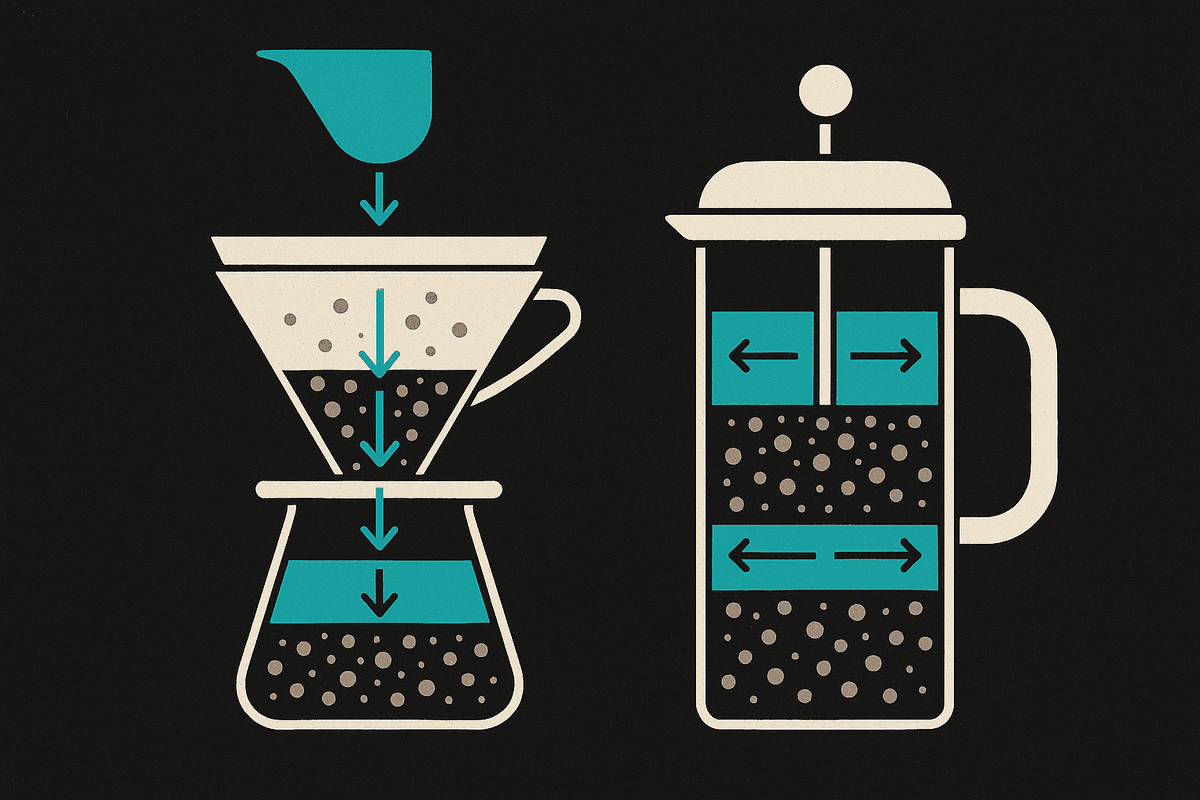
Percolation vs Immersion: Why the Same Coffee Tastes Different
Put the same coffee in a pour-over and a French press — same dose, same ratio, same temperature — and they won't taste the same. It's not technique or filter material doing all the work. The brewing physics are structurally different: one method keeps the concentration gradient steep from start to finish; the other self-limits as the liquid approaches equilibrium with the grounds. Understanding which regime you're in explains most of what you taste.
Oct 12, 20266 min

Sensory
What Gives Coffee Its Body
When an espresso coats the mouth and a pour-over rinses through, that difference isn't strength — it's body. Three things build it: dissolved polysaccharides that raise viscosity, melanoidins that form during roasting and add molecular weight, and oils that paper filters trap but metal mesh and pressure let through. Understanding the three lets you explain almost any mouthfeel difference between brew methods, roast levels, and grind sizes.
Sep 29, 20264 min

Roasting
How Strecker Degradation Builds Coffee's Aroma
Green coffee beans contain free amino acids that smell like nothing useful. At around 190°C those amino acids hit reactive compounds from the Maillard reaction and break apart — converting into Strecker aldehydes, the highly aromatic molecules responsible for coffee's malt, honey, chocolate, and floral notes. Here's the specific reaction chain, and why the bean's protein chemistry partly predicts the aromatic outcome before the roaster does anything.
Sep 22, 20265 min
Fair questions
- Where is Unlisted Coffee roasted?
- Unlisted Coffee is roasted in small batches in Austin, Texas. There's no café: the coffee ships in bags across the contiguous US, and the espresso cart turns up around Austin.
- How does Unlisted Coffee choose its coffees?
- We taste about ten lots for every one we buy, and only bring home the ones that made us grin. When a lot runs out it's gone, and the next coffee is whatever earns its spot.
- How fresh is Unlisted coffee when it arrives?
- Unlisted coffee is roasted in small batches in Austin, and every bag is printed with its roast date, so you can see exactly how fresh it is. Coffee tastes best 1–5 weeks after roast, so a very fresh bag is worth a few days' patience.
- Where does Unlisted Coffee ship?
- Unlisted ships free anywhere in the contiguous US, with no minimum. We don't ship to Alaska, Hawaii, US territories, or outside the US. Around Austin, local delivery is free on orders of $21 or more.
- What does the Perky to Quirky scale mean?
- Perky to Quirky is our 1–5 personality scale, and every coffee gets one. It says how wild the cup tastes, not how good it is: Perky is comforting and chocolatey, Quirky is bright fruit plus a producer who intervened.
- Can I book a coffee cart in Austin?
- Yes, our espresso cart does weddings, offices, markets, and events within 50 miles of Austin, and further with a mileage charge. Tell us the date and headcount and you'll see a ballpark right away.
Follow along
Fresh off the roaster.
Drops, brews, and behind-the-bench moments. Tag us in your pour.


Flavor and origin marks by OpenMoji, licensed under CC BY-SA 4.0.